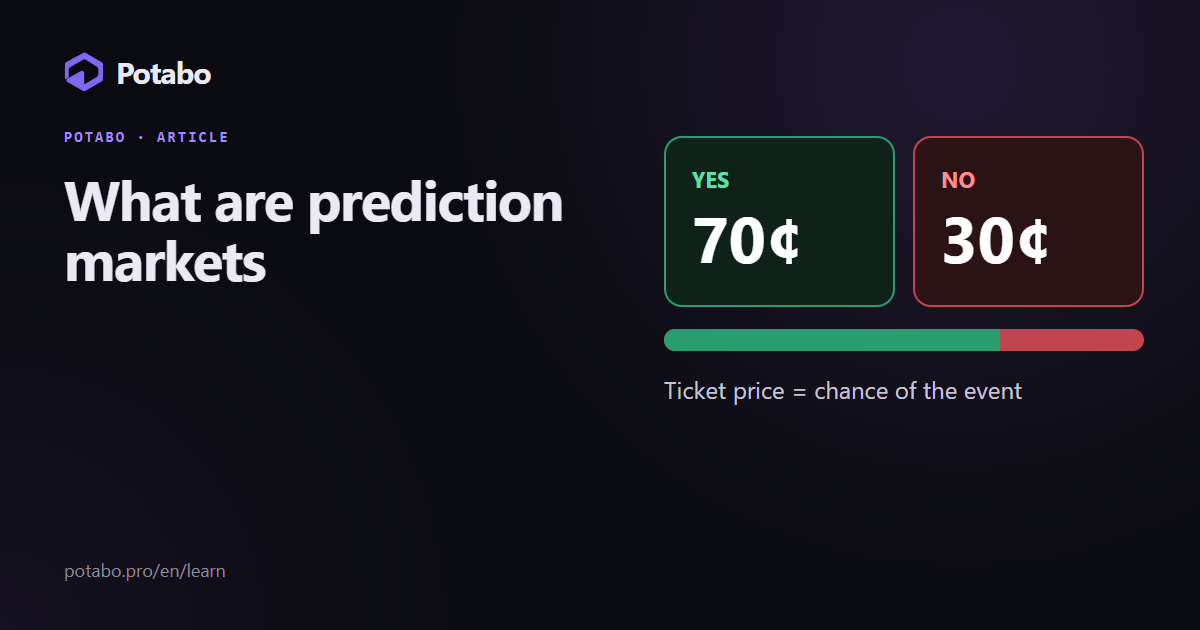
Two friends argue about whether it will rain tomorrow. One says "it will" and bets a candy. The other says "it won't" and bets a candy too. Tomorrow they'll know who was right, and the winner takes both.
A prediction market is the same argument, only for thousands of people at once and with real money. People trade on the outcomes of future events: "Will the Fed cut rates in December?", "Will Bitcoin be above $120,000 at the end of the month?", "Who will win the match?". The best-known venue for this is Polymarket.
How it works: an answer costs between $0 and $1
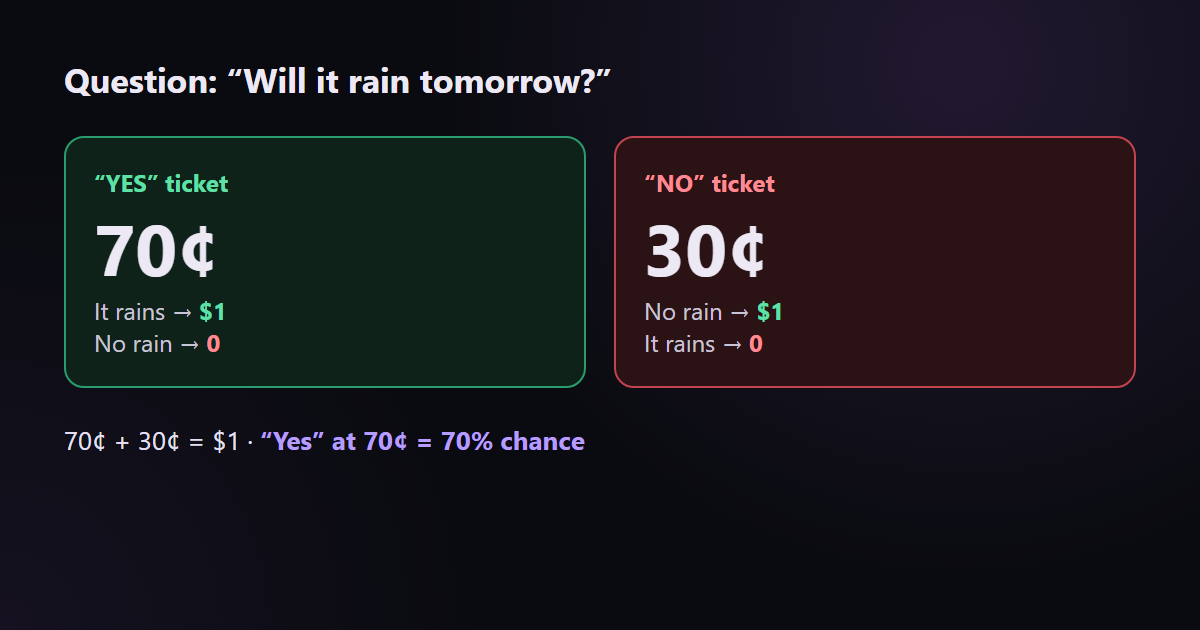
Take the same question: "Will it rain tomorrow?". Two kinds of tickets are sold — "Yes" and "No".
Tomorrow it resolves. If it rains, every "Yes" ticket turns into $1 and the "No" tickets expire worthless. If it doesn't rain, the opposite happens.
Today nobody knows what will happen, so tickets cost less than a dollar.
Why exactly 70¢? That's the price buyers and sellers agreed on. The more people are sure it will rain, the more expensive "Yes" gets. So you can read the price as a chance: a "Yes" ticket at 70¢ means a 70% chance. The "No" ticket costs about 30¢ at the same time. Together they make exactly one dollar, because only one of them wins.
On Polymarket these tickets are called shares. You can buy and sell them at any time until the event resolves.
Who sets the price
Nobody. People set it themselves: some buy, others sell, just like on a regular exchange. Whoever thinks the chance of rain is above 70% buys "Yes", and the price goes up. Whoever thinks it's lower buys "No".
That's the difference from a bookmaker. A bookmaker draws the odds himself, builds his margin into them, and you play against him. On a prediction market you trade with other people, and the venue only charges a trading fee — on many Polymarket markets there's no fee at all.
Why people trust prediction markets
When someone has their own money at stake, it pays to guess the truth, not what they want to hear. The price collects the opinions of thousands of such people into one number.
The idea isn't new. In 1988 the University of Iowa launched the Iowa Electronic Markets, an academic venue for trading on US election outcomes. Its forecasts were often more accurate than polls. Then came Intrade, PredictIt and Augur. Polymarket has been running since 2020, and Kalshi became a regulated event market in the US.
The real boom came with the 2024 US presidential election: billions of dollars were traded on Polymarket, and major media quoted its prices.
What kinds of markets exist
- Politics — who wins an election, whether a law passes.
- Economy — central bank decisions, inflation.
- Crypto — where Bitcoin will be by a date; plus separate 5-minute "Up or Down" markets.
- Sports and esports — match and tournament outcomes.
- Tech, culture, weather — whether a new AI model ships, who wins an Oscar, whether there'll be a heatwave.
You can browse live events in the Potabo market: it shows the percentages and the number of participants for each outcome.
How an event resolves
Every market has its rules written in advance: where the answer comes from and what counts as "Yes". On Polymarket the answer is recorded by the UMA oracle — a system where someone proposes an answer, and if nobody disputes it, it becomes final. After that, the winning tickets turn into $1 automatically.
Where the profit comes from
There are basically three ways:
- Know better than the market. You're sure the chance is higher than the ticket price — you buy. That's a forecast, and it may not come true.
- Catch price moves. Buy lower, sell higher, without waiting for the event to end.
- Use the market's mechanics. Look for moments when "Yes" and "No" together cost less than a dollar, when the price lags the news, or when the outcome is almost certain. Such windows last seconds, and programs take them — more on this in the article on algo trading strategies.
Worth remembering
How to try it without risk
Frequently asked questions
Is a prediction market the same as betting?
It looks similar but works differently. With a bookmaker you play against the house at its odds. On a prediction market you trade with other people, buyers and sellers set the price, and you can sell your ticket before the event ends.
Why does the price equal the probability?
The right ticket becomes $1. If "Yes" costs 70¢, a buyer is willing to pay 70¢ for a chance to get a dollar — so the market puts that chance at 70%.
Can I sell a ticket before the event ends?
Yes. Tickets are bought and sold all the time while the market is open. The price can rise or fall with the news.
Do I need crypto to trade on Polymarket?
Polymarket settles in a digital dollar (a stablecoin). In Potabo a wallet is created for you at sign-up, and you can top it up in the dashboard.
How accurate are prediction markets?
On large markets prices are usually accurate: events priced around 80% happen roughly eight times out of ten. On small markets the price can be random — there are few participants.
Live Polymarket markets and virtual money: test any strategy without risk.