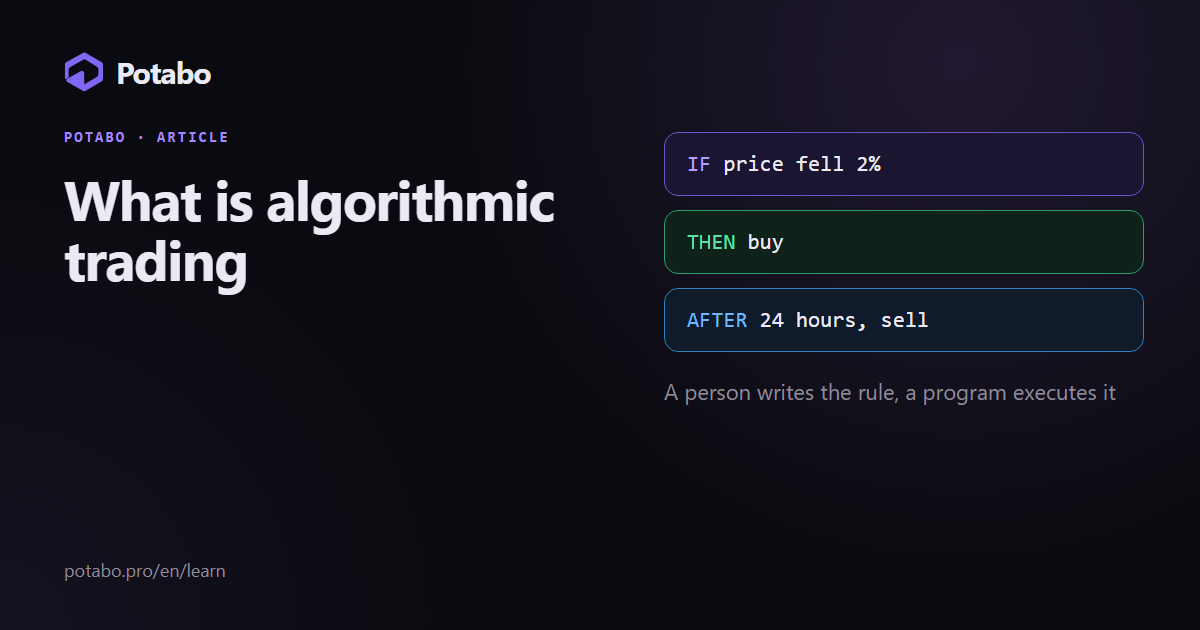
Imagine asking a friend: "If ice cream gets cheaper at the store tomorrow, buy me two. If it gets more expensive, don't." Your friend remembers the rule and does exactly that. Doesn't forget, doesn't change his mind, doesn't panic.
Algorithmic trading is the same thing, only a program does the work instead of a friend, and instead of ice cream it's stocks, crypto or event outcomes. A person comes up with a rule, and the program watches the market and follows it. Hence the name: an algorithm is simply a set of rules like "if this happens, do that".
Why a program does it better than a person
A program has three advantages:
- It's faster. While a person reads the news and reaches for the button, a few seconds pass. A program needs a thousandth of a second.
- It doesn't get tired. People need to sleep, eat and take breaks. A program can watch a hundred markets around the clock.
- It doesn't worry. When the price drops, a person gets scared and sells too early. When it rises, they get greedy and hold too long. A program follows the rule the same way every day.
But a person has something a program doesn't: understanding of what's going on around. That's why a pair works best. The person picks the rule and decides how much they're willing to risk, and the program executes it.
How it started: a short history
1970s: orders go over the wire
In 1976 the New York Stock Exchange launched the DOT system: for the first time orders reached the exchange electronically rather than through a broker at the counter. Not algorithms yet, but without this step there would be none.
1980s: the computer presses "sell"
Funds started buying and selling whole baskets of stocks on a computer signal. Automatic selling during the drop is considered one of the causes of the crash of 19 October 1987: programs sold at the same time and amplified the fall.
1990s and 2000s: exchanges go electronic
Trading became cheap and fast. High-frequency trading firms appeared: they earn fractions of a cent and place their servers right next to the exchange to win milliseconds. By the end of the 2000s programs made most trades in US stocks.
2010: a crash in minutes
On 6 May 2010 the Dow Jones fell almost a thousand points within minutes and bounced right back. After that, exchanges introduced automatic trading halts. The second lesson: automated trading needs brakes.
2010s: bots for everyone
With crypto, algo trading moved from banks to ordinary people. Services like 3Commas and Bitsgap offered ready-made strategies without coding. Open-source projects like Hummingbot let people run bots on their own computers.
2020s: prediction markets
Polymarket and Kalshi opened access to programs from the start, and bots arrived quickly. According to analyses of Polymarket's public leaderboard, most of the most profitable wallets are automated. They look not for "the right forecast" but for market quirks: price gaps, lags, nearly resolved outcomes. More in the article on algo trading strategies.
Why prediction markets suit programs
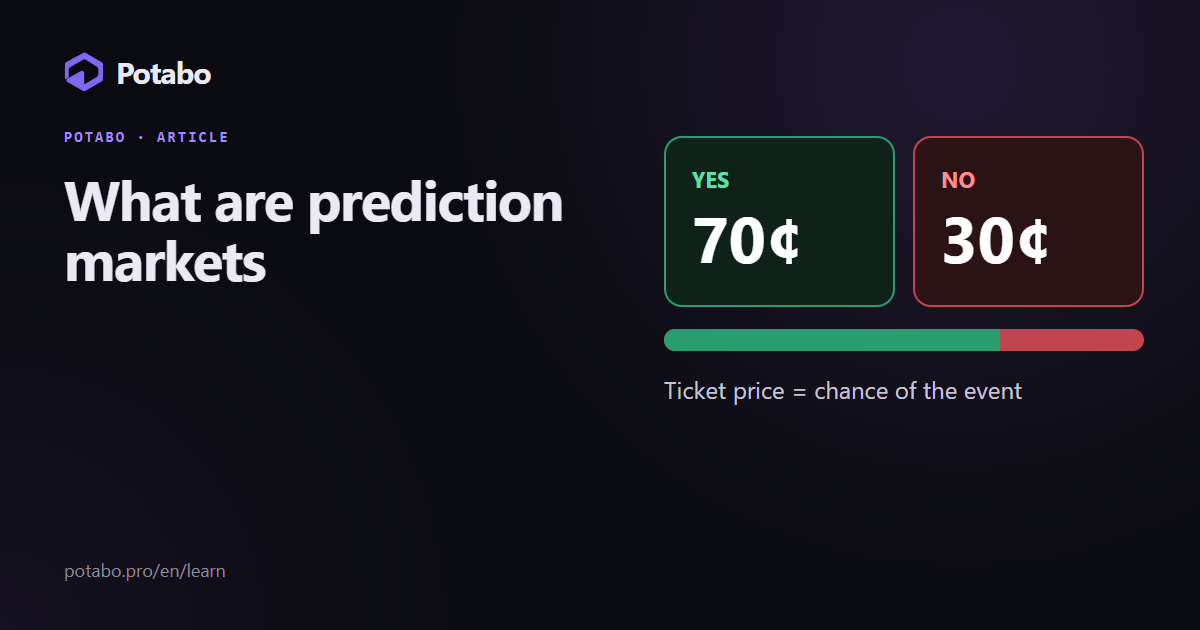
- Price = chance. A decision comes down to comparing two numbers: what the outcome costs and how likely it is. How that works — in What are prediction markets.
- Short markets. The 5-minute crypto "Up or Down" markets run 288 times a day. No person can keep up.
- A clear finish. The event resolves, and the ticket becomes either $1 or zero.
- Everything is visible. The order book is open: how much money sits at each price. That's ready-made input for rules.
How Potabo works on prediction markets
Algo trading on Polymarket used to be for people who write code: connect to the venue, run a server, take care of signatures and balances. Potabo turns this into a service.
Frequently asked questions
Is algo trading guaranteed income?
No. A program only follows a rule. If the rule doesn't work, the program will lose money quickly and neatly. That's why you test first — on demo.
Do I need to know how to code?
To write your own bot — yes. To use Potabo's ready-made strategies — no: everything is set with sliders and switches.
What's the difference between algo trading and a trading bot?
Algo trading is the approach; a bot is the program that executes it. In practice the words are often used interchangeably.
Are bots allowed on Polymarket?
Yes. Polymarket is open to programmatic trading and explicitly allows automated strategies. Country restrictions apply to bots too.
Live Polymarket markets and virtual money: test any strategy without risk.