Imagine a market where apples are sold. One seller earns because he guesses best when apples will get more expensive. Another buys from a neighbor around the corner cheaper and immediately sells higher. A third simply hears the news from the warehouse first.
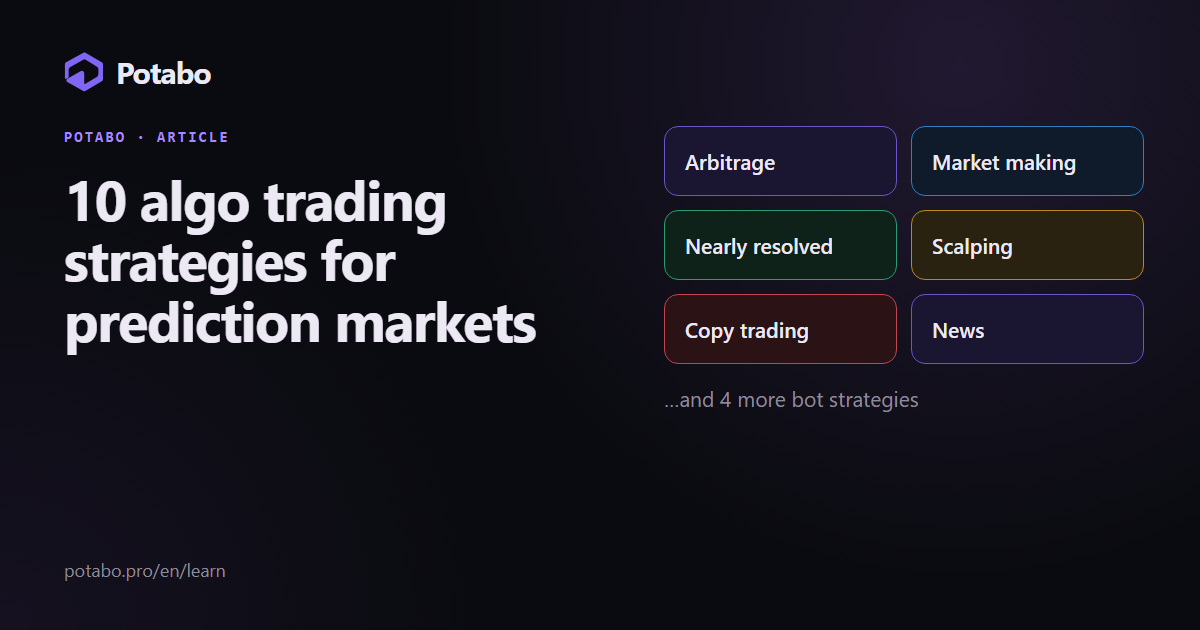
Prediction markets are the same. Algo trading strategies here usually don't guess the future; they use how the market works: price gaps, lags, nearly resolved outcomes. Below are the ten strategies most often found in open-source bots.
If you're new to the topic, start with What are prediction markets and What is algorithmic trading.
1. Single-market arbitrage
How it works. In a "Yes / No" question exactly one side wins, and its ticket becomes $1. If at some moment "Yes" and "No" together cost less than a dollar — say 48¢ + 49¢ — the bot buys both and is guaranteed $1.
The catch. Such windows last seconds, and the fastest bots fight for them. Fees easily eat the difference, and the money is tied up until the event ends.
2. Related-market arbitrage
How it works. Related markets must be consistent. "Bitcoin above $100,000" can't cost more than "Bitcoin above $90,000". The bot looks for such mismatches and buys the cheap side.
The catch. The link can be deceptive: different dates, different price sources, different rules. One mistake and the "arbitrage" becomes an ordinary bet.
3. Cross-venue arbitrage
How it works. The same event trades on Polymarket and Kalshi. If "Yes" on one venue is cheaper than "No" on the other, you can buy both sides and pocket the difference.
The catch. The rules differ in small details. You need accounts on both, and Kalshi isn't available everywhere.
4. Price lag
How it works. Bitcoin's price changes first on exchanges like Binance, and Polymarket's "Up or Down" markets catch up with a delay. A bot that sees the exchange faster buys at the old price.
The catch. It's a speed race: servers next to the venue, direct data feeds. Venues fight back — short markets now have a fee for those who take orders.
5. Market making
How it works. The bot places buy and sell orders at the same time and earns the difference between them (the spread). Polymarket also pays rewards to those who keep orders close to the price.
The catch. News comes out, the market jerks — and the bot is left holding tickets on the wrong side. Orders have to be moved constantly and positions limited.
6. Spread on small markets
How it works. On new low-volume markets the gap between buying and selling can be 10¢ or more. The bot places orders inside that gap and waits for counterparties.
The catch. Buying works, but selling at a fair price doesn't always: there are few buyers.
7. Nearly resolved outcomes
How it works. Buy outcomes at 93–99¢ shortly before the event ends. The win is small but frequent.
The catch. The gain per trade is small, so it matters that "nearly resolved" really is nearly resolved, not just expensive.
8. Scalping short markets
How it works. On 5-minute crypto markets the bot enters near the end of the round on the side the market already considers likely and holds until settlement. Details in Prediction market scalping.
The catch. The last minute decides everything, and fees on short markets are noticeable. Precise entry rules are a must.
9. Copy trading
How it works. The bot watches the wallets of strong traders and repeats their trades within your limits. All trades on Polymarket are public, so you can copy anyone. Details in Copy trading on Polymarket.
The catch. You enter after the leader and at a worse price. A trader's success may be luck, and some "leaders" are bots themselves that can't be caught.
10. News trading
How it works. The bot reads news and official sources and buys the outcome as soon as information appears that decides it — before the market reprices.
The catch. A misread headline, fake news or tricky market wording.
Strategies in Potabo
Frequently asked questions
Which strategy is the most profitable?
The one with positive expected value after fees right now. Markets change: yesterday's edge is taken by other bots today. That's why a strategy is checked on fresh data, not on stories about someone else's income.
Is it true that bots earn more than people?
According to analyses of Polymarket's public leaderboard, most of the most profitable wallets are automated. But that's a small group of well-equipped teams. Most market participants — people and bots alike — don't end up in profit.
Can I just take a ready-made bot from GitHub?
You can, if you know how to run code, keep a server and take responsibility for key security. Most such projects are educational: a working profitable strategy is rarely published openly.
What is a strategy's expected value?
The average result of one trade over the long run: the share of wins times the average win, minus the share of losses times the average loss, minus fees. If it's below zero, trading more often only speeds up losses.
Live Polymarket markets and virtual money: test any strategy without risk.